
PROJECT
Bridge Systems VR Team Training
CLIENT
German Armed Forces / Partner Armed Forces
AREAS OF APPLICATION
Vehicle Simulation / Bridge Construction / Operational Training / Maintenance / Multi-User Training Systems
Collaborative Virtual Reality Team Training for Mobile Bridge Systems
Client Requirements
Mobility and flexibility are critical factors for operations in challenging environments. In rough terrain, where infrastructure is damaged, or in the event of a disaster, such as after flooding or an earthquake, the ability to quickly and safely erect temporary bridges is of paramount importance. Modern bridge systems such as the M3 Amphibious Rig, the Floating Support Bridge (“Faltschwimmbrücke” FSB), and the Foldable Bridge (“Faltfestbrücke” FFB) enable the rapid crossing of bodies of water and obstacles, thereby making a vital contribution to ensuring supply, logistics, and access.
However, training for the deployment of these systems is complex: it requires technical understanding, precise vehicle control, and seamless team coordination. Traditional training is costly, resource-intensive, and often dependent on external factors such as weather or the availability of suitable training areas. At the same time, emergency responders must be prepared for real-world conditions, including currents, visibility, and team coordination under time pressure.
OUR SOLUTION
Immersive VR Team Training for Bridge Construction and Operational Training
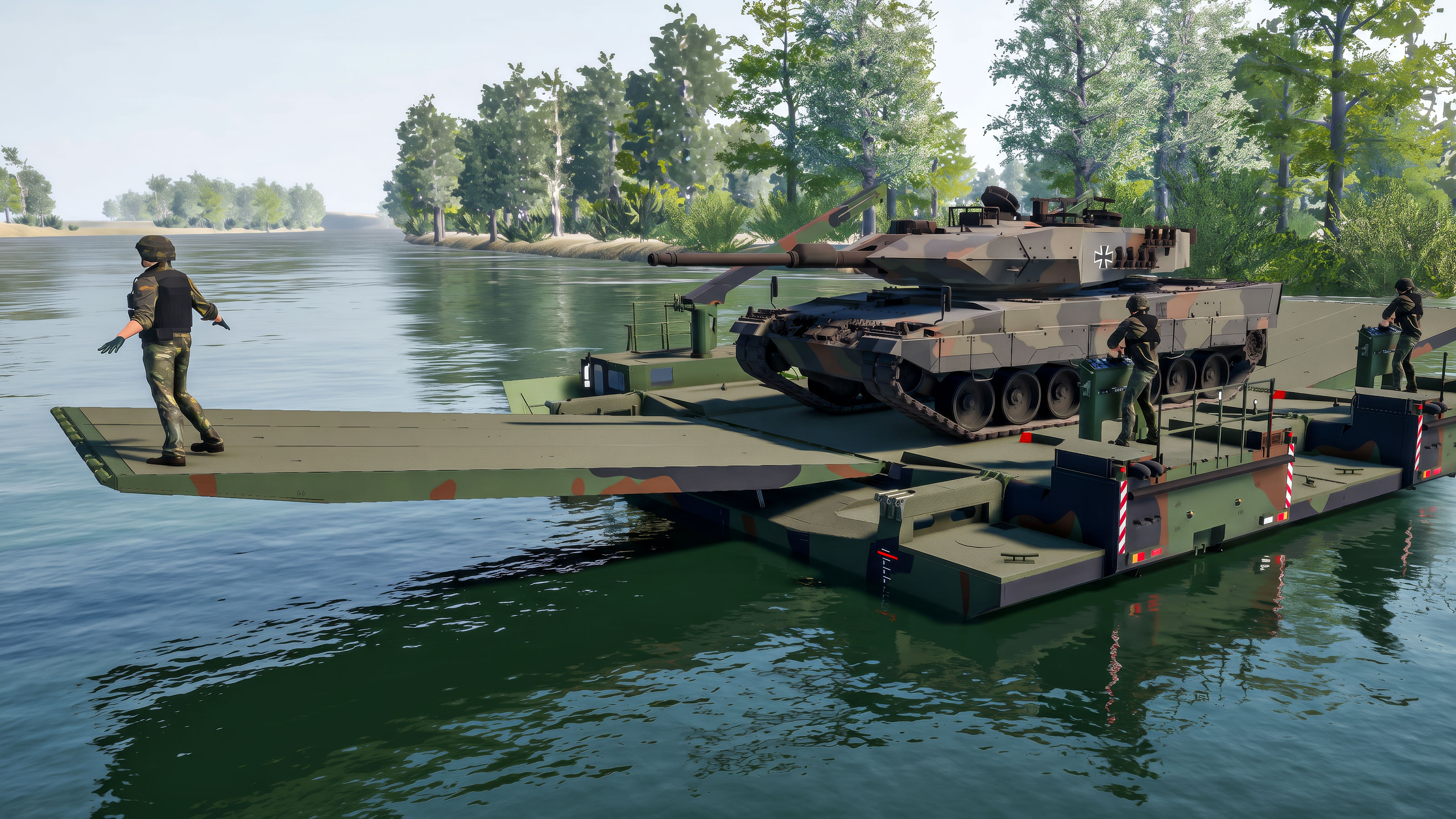
With the KoCUA (Cooperative Computer-Assisted Training) VR training system, SZENARIS has developed a flexible solution for practical training on modern bridge systems. The system enables cooperative, role-based VR training in which teams work together and make decisions under realistic conditions.
Digital Twin for Realistic Representation
KoCUA is based on the digital twin principle: Real-world systems were transferred into a virtual environment as detailed, interactive 3D models using CAD data. All functions and processes are fully available, allowing trainees to experience the system exactly as it operates in real-world scenarios.
Realistic Physics, Scenarios, and Operational Conditions
Factors such as current, wind, vehicle behavior, and environmental conditions are precisely simulated. The training environments are modeled after real-world deployment sites and replicate the entire bridge-building process, from reconnaissance and planning through construction and operation to dismantling and follow-up. This creates realistic training conditions for a wide variety of operational scenarios. Environmental conditions and scenarios can be dynamically adjusted to specifically train for certain situations and gradually advance the teams’ level of proficiency.
Collaborative Multi-User Training
Building bridges is a complex team process. KoCUA enables role-based collaboration in which participants take on different tasks, such as vehicle control, coordination, or assembly, while interacting directly with one another. Communication takes place realistically through speech and gestures, while motion-tracking technologies transfer movements directly into the virtual environment, thereby creating natural, action-oriented training situations.
Vehicle Simulation with Real-World Control Concepts
Control is achieved, among other things, via original control devices, allowing for realistic practice of vehicle simulation and the operation of complex systems. State-of-the-art VR headsets enable deep immersion in the training environment; supplementary displays offer flexible usage options even without a VR headset.
RESULTS & BENEFITS
Realistic VR team training for bridge construction and vehicle simulation without operational risks
Operational preparation for disaster and crisis scenarios
Reduction in costs, material usage, and logistical effort
Faster and more efficient training of operators and response personnel
Improved team coordination through cooperative multi-user training
High level of immersion for lasting learning success
Interested in a similar solution?
We develop customized VR training solutions for vehicles, field operations,
and complex technical systems.