
PROJECT
EMPOWER
FUNDING CONTEXT
EU Project MASTER-XR /
European Union
AREAS OF APPLICATION
Human-Robot Collaboration / Virtual Reality / Industrial Production / Ergonomics
VR Training for Human-Robot Collaboration, Workplace Safety, and Ergonomics
Client Requirements
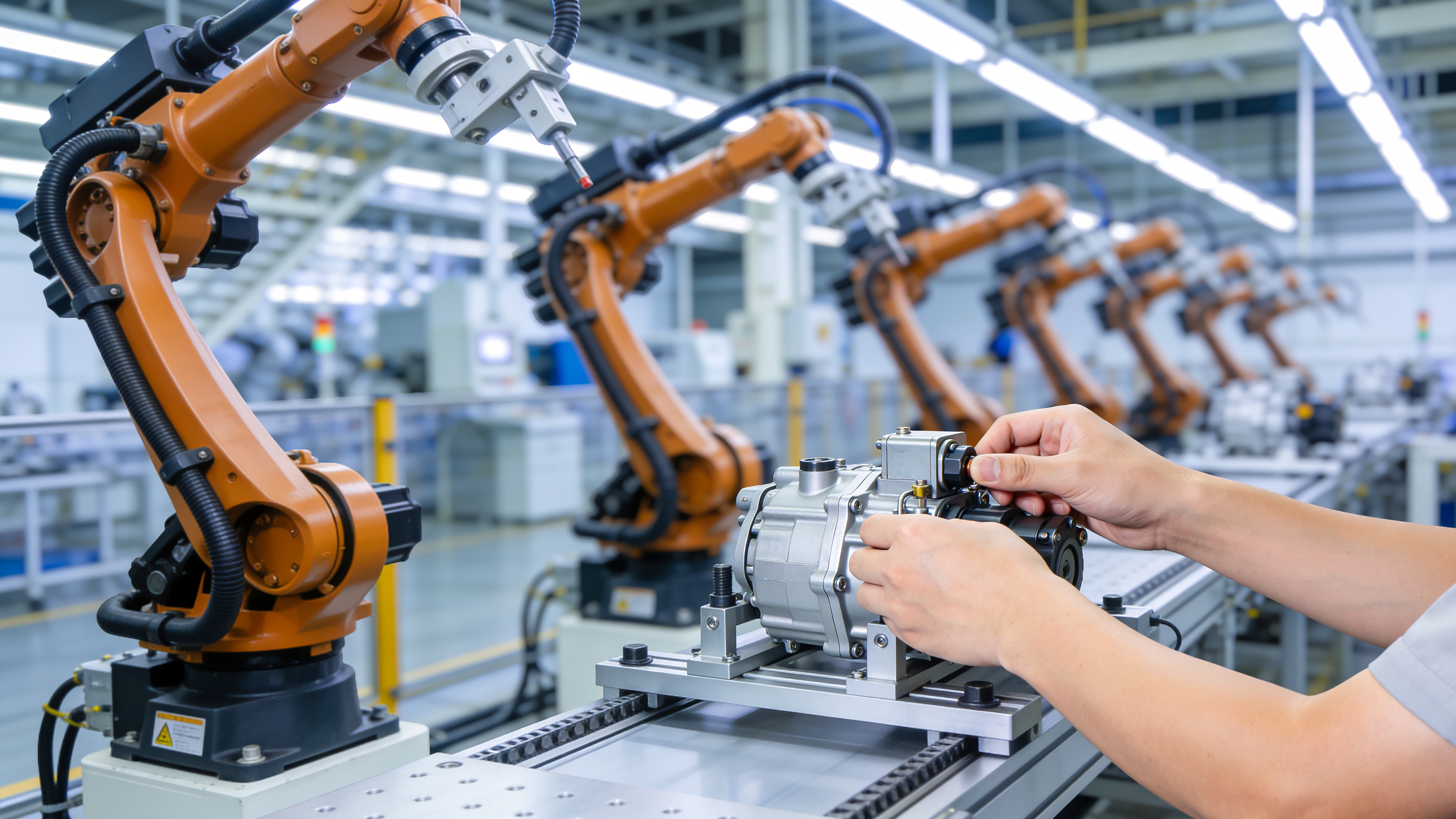
The increasing integration of robots into industrial production processes is creating new challenges for workplace safety and ergonomics. Particularly in safety-critical environments such as human-robot collaboration in assembly, employees must not only master technical procedures but also recognize potential hazards and work safely alongside automated systems.
Traditional training formats reach their limits here: They are hardly transferable to real, dynamic robot workstations, offer little opportunity for safe practice in hazardous situations, and do not adequately account for individual learning levels. At the same time, there is a growing need for scalable training concepts that can be flexibly adapted to different industrial scenarios.
OUR SOLUTION
VR Training for Occupational Safety and Ergonomics in Human-Robot Collaboration
SZENARIS is leading the project and, together with the Bremen Institute for Production and Logistics (BIBA) and five other partners from Greece, Spain, and Germany, is developing the EMPOWER VR training application. The project is part of the EU-funded MASTER-XR program, which provides an open XR platform for industrial training applications.
Real-World Use Case: Transformer Assembly
Development is based on the specific use case of transformer assembly, a safety-critical scenario involving close human-robot interaction. Employees can safely navigate realistic hazardous situations and actively test their behavior when working alongside automated systems. This use case serves as a blueprint for transferability to comparable industrial environments.
Modular VR Training for Maximum Flexibility
The VR training has a modular structure and includes specialized submodules for real-time visualization of robot movements and hazard zones, a digital assistant to guide the learning process, an HRC knowledge database, data collection for evaluation purposes, and components for safety and ergonomics assessment. The modular structure allows for targeted adaptation to various safety-critical industrial scenarios.

RESULTS & BENEFITS
VR training for safety-critical human-robot collaboration without any real risk of injury
Modular design for easy adaptation to different industrial scenarios
Improved workplace safety and ergonomics through immersive training environments
Active skills development for safe collaboration with automated systems
Integration into an open EU platform for broad accessibility and scalability
Interested in a similar solution?
SZENARIS develops VR- and XR-based training applications for workplace safety,
ergonomics, and industrial training.